


Introduction: Search Is Changing Quickly. Here’s Why.
How people look for information online is being radically transformed. In the old days, all you needed was search engine optimization — or SEO. But today the rules are much different.
Question-answering is now upended with AI-based tools like ChatGPT, Google’s AI Overviews, Perplexity AI and voice apps answering questions directly. Increasingly, it is not enough simply to appear on the first page of Google. You also want to be the source that those A.I. tools trust and cite.
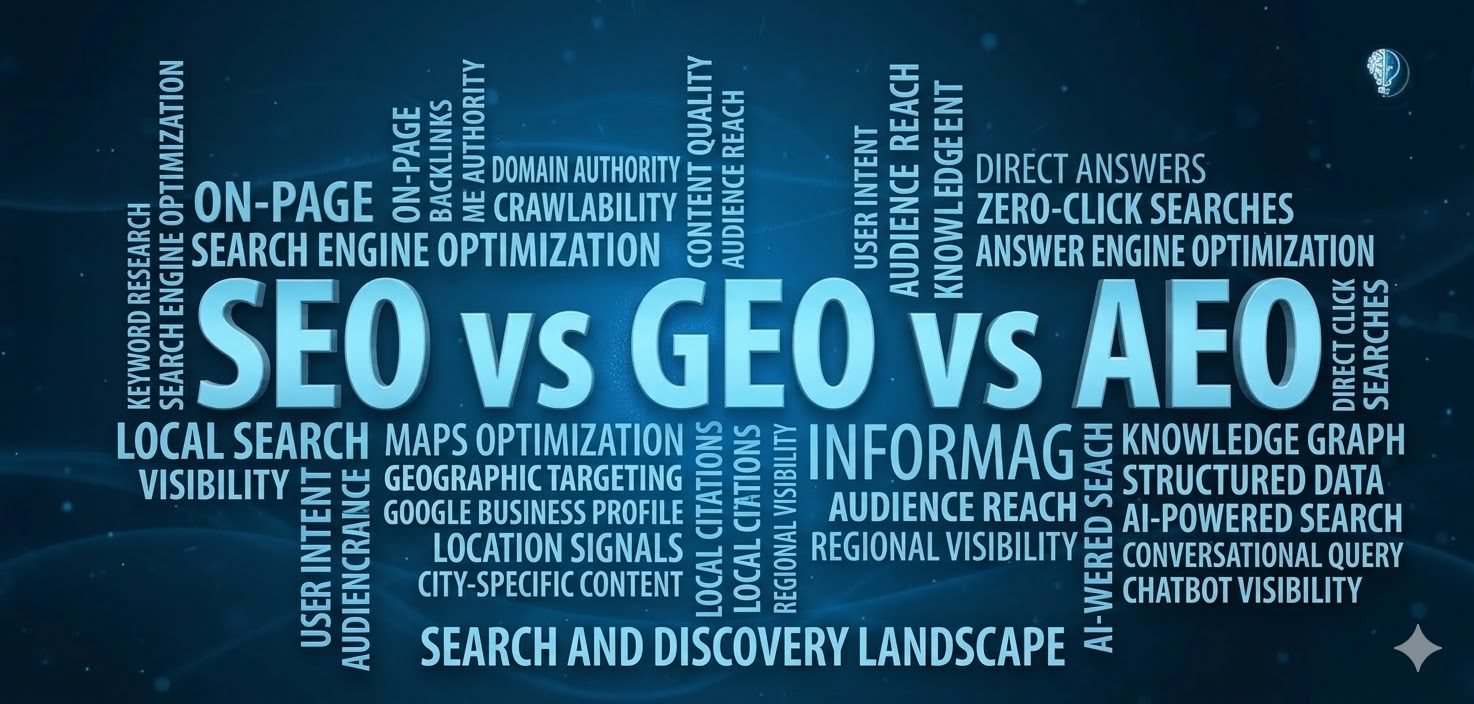
Those three pillars define the nature of search success today: SEO is Search Engine Optimization, AEO is Answer Engine Optimization and GEO is Generative Engine Optimization. Brands that figure out all three will win the future of search.
In this guide, we will touch on what each strategy means, how they differ from one another (and the next) and most importantly — exactly how to combine all three and see your visibility skyrocket online.
SEO vs AEO vs GEO – The Future of Search Optimization
What Is SEO (Search Engine Optimization)?
The abbreviation SEO stands for search engine optimization. In a nutshell, it is to put your website to the top of search engines like Google, Bing or Yahoo. SEO — short for search engine optimization — is what creates a good place on the page when someone types a question into Google.
For example, if a person searches for “best coffee shops in New York,” SEO will dictate the order and placement of which coffee shop websites show on page one. More exposure that leads to more clicks, more visitors and eventually customers.
Key Components of SEO
SEO has three main pillars, and knowing what each pillar means is the first step:
On-Page SEO: This is all about what you do to your website pages.
• Including target keywords in your content but doing so naturally
• Creating powerful titles and descriptions
• Writing descriptive image alt attributes
• Forming headings structure logically (H1, H2, H3)
• Creating helpful, high-quality content that satisfies user queries
Off-Page SEO: Outside signals that are not directly on your website.
• Creating links to your website from high-quality, credible sites
• Earning brand mentions all over the web
• Handling your digital persona and reviews
• Brand awareness and social media signals
Technical SEO: This allows search engines to crawl and index your site correctly.
• Quick page load times (less than 3 seconds)
• Mobile-friendly and responsive design
• Secure HTTPS connection
• Structured site architecture and XML sitemaps
• Repairing crawl errors and dead hyperlinks
What Is AEO (Answer Engine Optimization)?
AEO: Answer Engine Optimization Optimizing your content means making it the selection of AI -based answer engines — Google’s featured snippets, Siri, Alexa, and Google Assistant — so that your answer is pulled up and forwarded to users.
In other words, AEO is about being the direct answer, not one of many results. For instance, when someone asks Alexa “What is the best diet for weight loss? AEO is what decides whose voice you hear when Alexa reads an answer.
As voice search continues its meteoric rise, AEO has become an essential skill for any owner of a website.
Core Elements of AEO
• Featured Snippets — Concise, direct answers that sit in a special box at the very top of Google results (a.k.a “Position Zero”). Securing this position brings enormous visibility, with users not even needing to click your link.
• Voice Search Optimization — Formatting your content so voice assistants like Siri and Alexa can read your answer soundly. Voice answers are generally 29 words or less using conversational tone.
• Structured Data (Schema Markup) – Applying special code to your website that provides insight for search engines about what type of content you have precisely. For example, FAQ schema has Google know your page holds questions and answers.
Question-based Content — content written that answers specific questions directly, like “What is…”, “How does…”, “Why should…”. This imitated how real people spoke and searched.
What Is GEO (Generative Engine Optimization)?
GEO — or Generative Engine Optimization is the latest and greatest frontier for search. Its the art of refining your content so that AI-driven generative frameworks like ChatGPT, Google Gemini, Perplexity AI, Microsoft Copilot and Google AI Overviews refer to your website as a source they can trust.
Moreover, GEO matters because millions of people now obtain answers via AI chatbots — never even reaching a search results page. If an AI tool trusts your website, it will reference you in its responses and may link to you.
How GEO Works?
Tools like generative AI train on large swaths of web content. But while constructing a real-time answer, they additionally pull in up-to-date details from reliable sources. GEO is all about being that trusted source of information for your customers.
In short, GEO works when it incorporates a mix of signals from your website including authority, content clarity, semantic keywords in use, clean structures and how direct your answers on the pages are.
Why Brands Need GEO Right Now
• AI Overviews now sit at the very top of Google — above traditional results
• 100 million daily users of ChatGPT asking questions and trusting AI answers
• Perplexity AI cites sources directly, sending referral traffic to optimized domains
• GEO optimization has become an essential need for brands not to be invisible to a whole generation of searchers
AI Citation Optimization
AI engines will only cite authoritative, well-structured and factually accurate content. Expert jargon with sourcing and sharp concept definitions — the favored fare of academic publishing — is music to AI tools’ ears. In addition, maintaining strong backlinks and having higher domain authority lends your website credibility in the eyes of AI.
Key Differences (Comparison Table) Between SEO vs AEO vs GEO
The following table summarizes at a glance the core differences between SEO, AEO and GEO:
Category SEO AEO GEO
SEO Trends of 2024 Data up to October 2023 Direct answers AI-based results
ChatGPT, Gemini, Perplexity, AI Summarizers Platforms Google Bing YahooSiriAlexaGoogle Assistant
Content Type Long-form, keyword-rich Concise, question-based Authoritative, structured, cited
Objectives Receive better rankings Get rich snippets Featured in AI
Tools Keywords, backlinks and meta tags List all structured data with FAQ schema Semantic keywords along with AI friendly formatting
Measurement Rankings, organic traffic Featured snippet wins, voice hits AI citations, brand mentions in AI
As you can see, the strategies target various levels of the search ecosystem. So the best digital marketing strategy is a mix of all three.
Want to know how to optimize your website now for SEO, AEO & GEO?
Use any of these seven tried and true steps to start ranking on search engines, capturing featured snippets, getting cited by AI tools:
Step 1: Keyword Research
It all starts with the words and questions used by your target audience. To identify high-value keywords, use tools such as Google Keyword Planner, Ahrefs or Semrush. Also, target long-tail words and including questions such as “How do I…” or “What is the best way to…” — both AEO and GEO do well with these.
Step 2: Create Question-Based Content
Build your content around very real questions. Such as write a blog post like, “What Is GEO? or “How Does Voice Search Work? Answer every question, directly and concisely, in the first paragraph. This is similar to how voice assistants and AI tools access information.
Step 3: Feature Snippet Optimization
Use clear definitions and numbered lists to grab the coveted “Position Zero” on Google, along with short summaries. Answer in 40–60 words directly. Also, post the exact question as a headline (H2 or H3) after that give straightforward straight answer right below it.
Step 4 – Implement Structured Data (Schema Markup)
Use schema markup on your site so that search engines and AI tools can better comprehend your content. The schema types that are most valuable for AEO and GEO: FAQ Schema, How-To Schema, Article Schema and Organization Schema. Google provides a free Structured Data Markup Helper, which allows you to generate schema code.
Step 5: Create Authority Content
Credible, well-sourced content is favoured by AI engines. So, support your claims with data, statistics or expert quotes. Also: Update your content frequently, reference authoritative links, and show real expertise. Because ChatGPT tends to favor authoritative sources, content which shows genuine authority has a much higher chance of being cited directly by it and appearing in Google AI Overviews.
Step 6: Use Fast Websites with a Great UX
All three strategies are hindered by a slow website. Use Google PageSpeed Insights to see your speed. Try to keep load time less than three seconds. Also make sure your site is mobile-friendly, easy to navigate and doesn’t have technical errors. For SEO it is a ranking signal, for GEO — credibility signal.
Optimize for AI & Voice Search — Step 7
You are a sentence rephraser. Use simple vocabulary and short sentences. Format your content in a way that an AI could provide a 1–2 sentence answer. Finally, you also want to include semantic keywords — words that are associated with your main topic and support the meaning — to help AI tools comprehend your content’s context.
GEO Optimization Checklist
Check this list to confirm that your website will be fully optimized for AI-driven search by 2025:
✅ Organize every page of your site with clear headings (H1, H2, H3)
• ✅ FAQ schema on pages with questions and answers content
• ✅ Responses should be direct, like a structured answer in the initial 60 words of each segment.
• ✅ Craft data-driven content supported by research and evidence
• ✅ Sprinkle in related phrases and semantic keywords throughout your content
• ✅ Use internal links to link together relevant pages from different areas of your site
• ✅ Avoid lengthy paragraphs, write short paragraph, AI friendly (Max 2–4 sentences per paragraph)
• ✅ Deliver a crystal-clear author bio and credentials to establish E-E-A-T signals
• ✅ Gain valuable links from top websites in the niche
• ✅ Keep your content up to date with current information and statistics
• ✅ Use colloquial language similar to how humans talk to voice assistants
• ✅ Include an FAQ section at the bottom of key pages to cover voice queries
Future Trends in Search Optimization
The search environment will remain in continuous flux. Here are five key trends that every website owner should be aware of:
- Search, Now Powered by AI, Is the New Normal Now not only billions of users but also Google shows its AI Overviews. At the same time, millions of people are using ChatGPT or Gemini or Perplexity instead of traditional search. This has made GEO equally as important as SEO – with the two working hand in hand for optimal results.
- Zero-Click Searches Are Increasing. Studies show that now more than 65% of Google searches end up without a click. Featured snippets, AI Overviews, and knowledge panels directly answer the inquiry in the results page. Hence it is critical for visibility that your answer is featured.
- Voice Assistants Are Everywhere. Smart speakers, smartphones and wearables also mean that voice search is growing at an unprecedented rate. Voice searches tend to be more conversational, longer, and question-oriented. Voice optimization has graduated from the realm of options to necessity.
- Generative Search Engines Are Multiplying. Every month, new AI search tools are being launched. Perplexity AI, You. are transforming search, changing how we locate information. Moreover, the integration of AI in Microsoft Bing has transformed the way Bing presents its results.
- E-E-A-T Will Define Who Wins. Google’s quality framework — Experience, Expertise, Authoritativeness and Trustworthiness — is more important than ever. AI tools also have a bias toward content that exhibits real expertise. Ultimately, when real, helpful content (not the AI junk) is inserted into their colors, a preference will allow one to excel over the other.
Conclusion
The future of search is here, and it belongs to those who move forward. Tennis and Swimming are not competing sports. In fact, they are foundational layers of a comprehensive, future-ready search optimization strategy.
SEO ensures people will be able to discover your website. AEO places your content at the center of their inquiry. GEO also helps build trust of AI tools such as ChatGPT and Google AI Overviews to your website and establishes it authoritative.
So the best websites, come 2025 and beyond, will be those that master all three. And so: Start with your solid SEO bedrock, build up on that layer by implementing AEO for featured snippets and voice search, and finish off with your GEO level — where you make sure to create authoritative content and optimize it for AI consumption.
The search environment is rapidly changing. Yet the basics are unchanged: write truly helpful, well-structured, expert content — and you will be rewarded by both humans and AI tools.
Frequently Asked Questions (FAQs)
Q1: How is AEO different from SEO?
SEO (Search Engine Optimization): This is about getting your website to rank better on organic search. AEO (Answer Engine Optimization), on the other hand, is about ensuring your content is the exact, featured answer AI assistants and search engines give. In other words, SEO focuses on clicks out of a list of results and AEO boosts your chances to be the best answer.
Q2: What does GEO mean in the digital marketing?
GEO means Generative Engine Optimization. This involves optimizing your website content so AI-powered tools — including ChatGPT, Google Gemini, Perplexity AI and Google AI Overviews — consider your site a trusted authority to include in their answers. It is the most recent and most rapidly developing subset of search optimization.
For voice search phrasings, where these results may often appear (especially for questions), AEO will be the more significant look of the two.
Siri, Alexa and Google Assistant can only read out one answer to a query. So if your content is the featured snippet or top AEO-optimized result, it is the only answer that millions of people will hear. And as voice search continues to spread — particularly on mobile devices and smart speakers — AEO is critical for catching this traffic.
Q4: How do I optimize my website for AI search engines?
Optimizing for AI Search Engines To optimize for AI search engines, here are a key few steps to take: Use clear H1, H2 & H3 headings Write concise, direct answers to common questions FAQ Schema Add structured data Create authoritative content backed by data and expert insights Semantic Keywords Regular updates. High-quality backlinks also indicate to AI tools that your site is reliable.
Q5: Does SEO still matter in the age of AI?
Absolutely, yes. SEO is still the backbone of every digital search strategy. However, its role has evolved. So the traditional search engine optimization still makes it feasible for search engines to index and crawl your website. AEO and GEO are built on that foundation, capturing AI-powered search traffic and voice search respectively. Hence, the best way to go about things is through a single strategy of using SEO and AEO and GEO in conjunction.